
 Français
Helping teachers create custom Learning Games for their courses (Ludifik’action)
Date: 01/2017 - 01/2027
Funding: Autres
Call: financement prix PEPS 2018
Partners: UBLURL: http://lium.univ-lemans.fr/wp-content/uploads/2023/07/Fiche-Formation_Ludifik-action_10-07-2023.pdf
LIUM Participant(s): |  Iza Marfisi Iza Marfisi |  Sébastien George Sébastien George |  Bertrand Marne Bertrand Marne |
Ludifik’action professional training course given by the LIUM researchers
The use of Learning Games (Serious Games) has never been higher. In parallel to popular digital Learning Games, which show great results for learning, but are very costly and time consuming to develop, we propose a simpler solution to help teachers create custom Learning Games for their courses. The objective is to educate teachers about what a game is made of and the way they can be used effectively for learning in various educational contexts.
The ambition of this annual professional training course is to accompany teachers in the creating of a custom Learning Game for their specific educational objectives.
It has already accompanied the creation of more than 35 serious games (digital and non-digital), curretly used in all of France. The list is on the french version of this page.
Awards and Distinctions
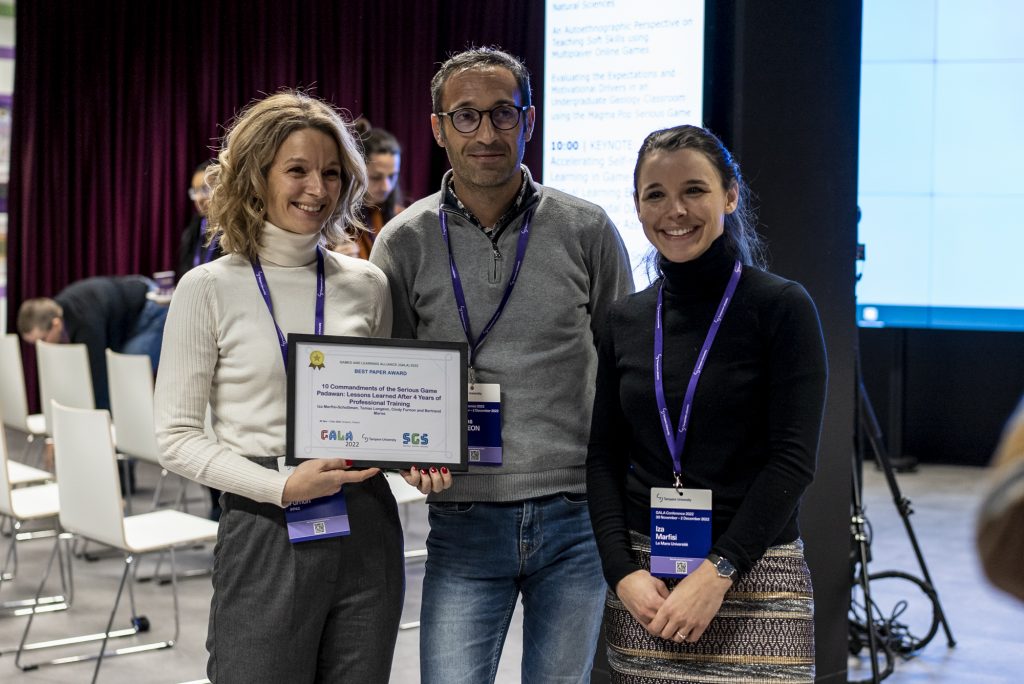 In 2022, we published a paper about the lessons learners during our traning session at the Games and Learning Alliance internarional conference. The paper was written and presented with two former trainees.
The scientific article won the Best Paper Award of the conference!
10 Commandments of the Serious Game Padawan: Lessons Learned After 4 Years of Professional Training
Iza Marfisi-Schottman, Longeon Tomas, Furnon Cindy, Marne Bertrand

In 2018, this course was awarded with the national PEPS 2018 prize, and a 10K grant.
Public:
Trainers, teachers, pedagogical engineers
Prerequisites:
To have taught children, students or adults (professional training), whatever the level or the content of the course.
Format:
- Le Mans University offers a complete training session on an entire semester.
- Other formats are possible on demand: introductory seminar of a few hours, one-day course, workshops for specific needs of a company or school…
Pedagogical Objectives
At the end of the course, the trainee will be capable of:
- Identifying the principal technics to add game mechanics in an educational situation.
- Modifying (modding) a tabletop game in order to integrate learning objectives.
- Defending their choice of game mechanics given the desired learning outcomes.
- Designing a Learning Game, which meets their personal learning objectives and education context.
- Editing a first Learning Game prototype: infographics, pawns, dice, cards, board, box, booklet for the game rules…
- Using the designed Leaning Game in the real educational context with children, students or adults.
- Writing a guide, for other teachers, to explain how the Learning Game can be integrated into a course.
- Writing an article, for colleagues and senior teachers of their school, that will inform them of their new pedagogical initiative and convince them that the proposed Learning Games is enhancing the learning outcome.
Content
Number of hours:
- 12 hours of group practical sessions
- 1 hour of face-to-face meeting with the trainee
- 30 minutes of online tutoring
- Approximately 6 days of work in autonomy
Organization:
Kick-off day (6 hours)
- 30 minutes’ introduction on Learning Games
- 30 minutes’ presentation of examples of Learning Games used in companies, school and universities
- 1.5 hours of modding tabletop games to add learning objectives
- 30 minutes of debriefing session
- Lunch break
- 2 hours of Learning Game design: the trainees work on ideas of Learning Games for the course that they teach
- 30 minutes’ presentation of services that can facilitate the creation of Learning Games: fablab, reprography, university pedagogical services, pedagogical grants…
- 30 minutes of summary: each group present the idea they have come up with for their Learning Games, followed by an open discussion
Work in autonomy (6 days + 30 minutes tutoring + 1 hours meeting)
- Creating the Learning Game prototype and testing it (2 days)
- Face-to-face meeting with the teacher at the trainee’s teaching site (1 hour)
- Improving the Learning Game (1 day)
- Working on the look and feel of the game and editing the game material (1 day)
- Testing the Learning Game with students (1 day)
- Writing the teachers’ guide and the article (1 day)
Final day (6 hours)
- 2.5 hours of presentation of the Learning Games designing during the training course: each group describes their game, the difficulties encountered and the work that still needs to be done.
- Lunch break
- 3 hours of testing the Learning Games and suggesting improvements
Pedagogical methods and tools
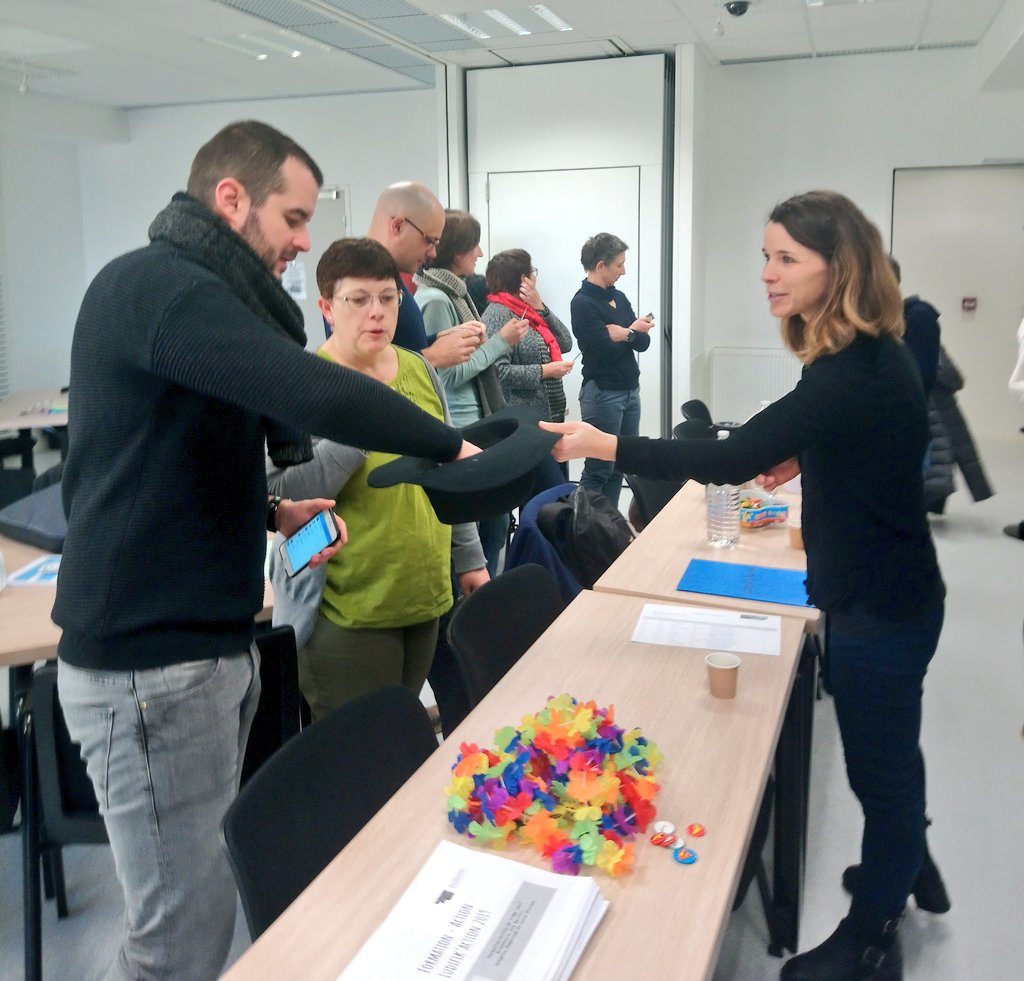
The trainees need to sign up as a team with one pedagogical project. The team can be composed of two teachers but the ideal situation is to have one teacher and one pedagogical engineer that come from the same company or establishment. Even if this seems like a constraint, the constitution of this team is essential to facilitate the design and the adoption of a new pedagogical initiative, but also to have more weight against various forms of resistance.
The engagement of the trainees is essential, since the objective of this professional training is to accompany them in the creation of a custom games, designed to fit their specific needs. This course therefore cannot function if the trainees do not have a specific course to work on and if they are not willing to change the way they teach it.
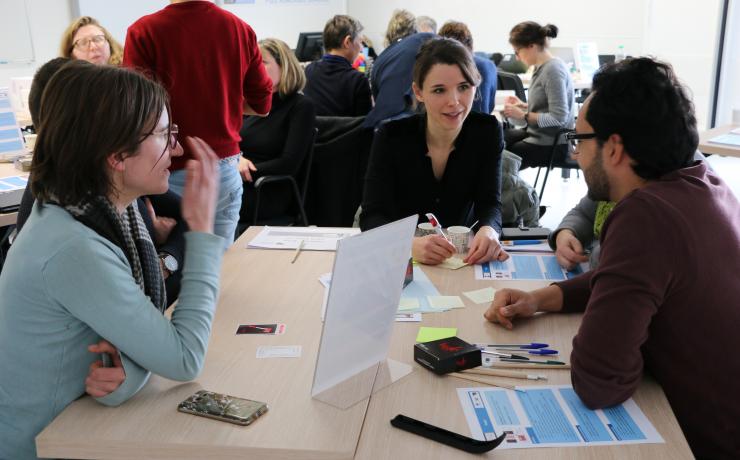
The course is, itself, gamified. The use of game mechanics allows to create a relaxed and friendly atmosphere, that is necessary for the co-design of Learning Games. In addition, it allows the trainees to experience the use of various types of games for teaching and to get a feel for their advantages and disadvantages.
All along the course, the trainees are provided with theoretical guidelines and methods that they use during the practical training sessions. It will allow them to understand the process of integrating game mechanics to enhance a course and, on a long-term, develop their own expertise to help other teachers that want to try Learning Games.
The trainees have access to an online UMTICE course platform with all the resources. This platform is also used to answer questionnaires on game mechanics and deposit their final productions (game mock-up model, teachers guide, article). A large collection of tabletop games will also be at their disposal for inspiration.
Course Validation
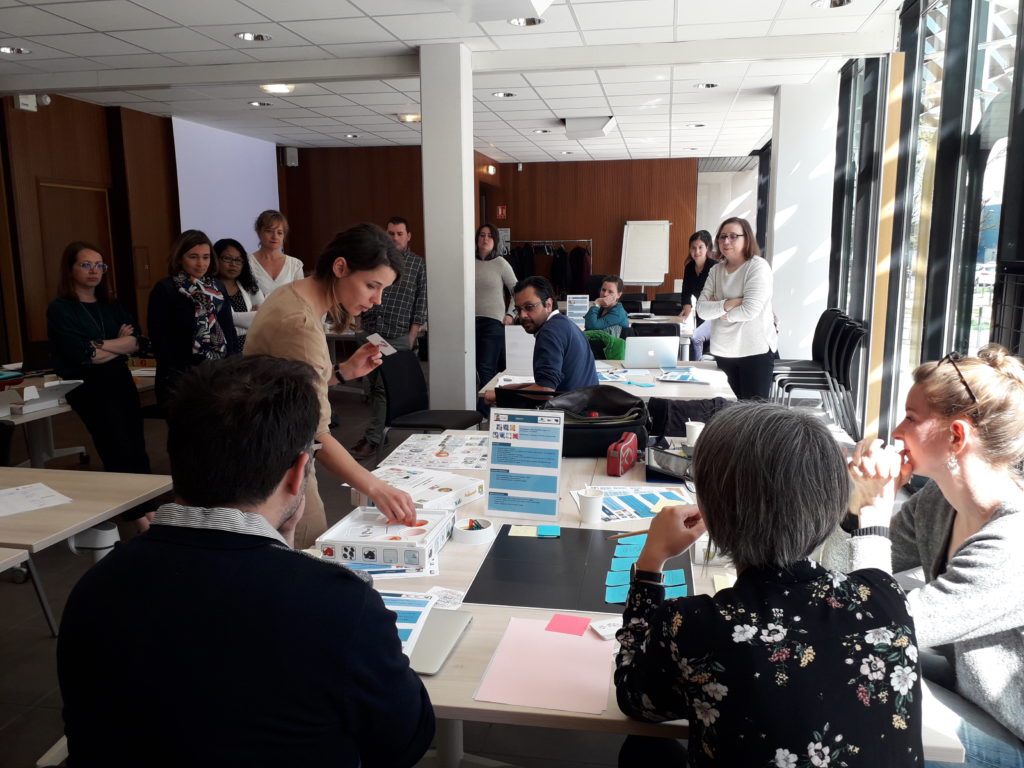
The course will be validated depending on the participation of the trainee and the quality off their productions (Learning Game, teacher’s guide and article), but also depending on the effective integration of the Learning Game in their course.
This is the list of the elements that are taken into account for the trainee’s certification:
- Participation to the kick-off day
- Results of the online questionnaire on game mechanics
- Quality of the designed Learning Game (look and feel, learning content and choice of game mechanics)
- Quality of the teacher’s guide
- Quality of the article
- Use of the Learning Game in class (tests with colleagues, with a small group, with the entire class…)
Already 43 Serious Games designed during this training program:
- La sagesse du Duc – Interactive AI-based installation allowing users to converse with the late Duke de La Rochefoucauld and understand the origins of engineers – Alexandre BRAD, Antoine OGER – Master TEEF students in a work-study program at the Museum Forum de la Technologie of the Arts & Métiers Foundation.
- DigeOPI – Board game to understand Industrial Organisation and Management (OPI) – Nathan REY, Erwan NICOLINI – Master TEEF students in a work-study program with the IUT of Aix-en-Provence.
- Le Grand Voyage – Develop your skills to save humanity. A game designed for teaching teams beginning Competency-Based Approaches – Sébastien BOYAS, Sabine CHAGNAUD, Mélanie MESSAGER and Tifaine INGUERE – STAPS, Le Mans University.
- Fix it! Tutors Edition – A game to prepare tutors for tutoring situations – Maureen CAVARLÉ, Amandine MAURICE, Isabelle RABY, Tifaine INGUERE and Raphaël LALANN – Tutoring Unit, Language Centre, Le Mans University.
- Le passe-parole – A playful activity within an elective module to share and pool students’ diverse experiences – Juline MESSAGER, Yasmine REZVANI and Tifaine INGUERE – SUIO-IP, Le Mans University.
- Mission Ingé Péda – A game to initiate effective collaboration between teachers and instructional designers – Florence BRUNEAU, Yannah ALDRIN-PESSIN – Educational Engineering and Media Support Service, Université de Bretagne Occidentale.
- Climatopoli: The Sustainable City – A game on ecological and environmental issues – Céline JANSSENS and Nathalie BERNARD – private trainers.
- Poly Boat Project – Project management through gameplay – David FREIN, Virginie HAAS – Polyvia Formation.
- Escape from PharmaZ – An Augmented Reality game on pharmacophores – Olivier DELALANDE, Audrey LACHAL, Camille BISSON – Pharmacy Department, University of Rennes.
- Transmission d’entreprises – A board game to understand business takeover and transfer – Karine LE RUDULIER, Léo RAGAIGNE, Camille BISSON – IGR-IAE Rennes, University of Rennes.
- Historicol – An escape game to learn about the history of the university’s collections – Marion LEMAIRE, Julie PRISER, Anne LAUTROU – Cultural Department, University of Rennes.
- Elections municipales – A game to understand the mechanisms behind municipal elections – Xavier VOLMERANGE, Julien LASSIMONNE – Faculty of Law and Political Science, University of Rennes.
- Concept Physique-Acoustique – A board game for future speech therapists – Renaud DELANNAY, Sean Mc NAMARA, Julien LASSIMONNE, Camille BISSON – UFR SPM, University of Rennes.
- Cap au BUT – A game to understand the portfolio concept in the BUT degree – Monika SALMON, Camille BISSON – IUT of Social Careers, University of Rennes.
- Projet cotte de mailles – Digital game to learn how to differentiate cellular walls – Aurore CAROUSO, Tiphene GALPIN, Tifaine INGUERE, Raphaël LALANNE and Franck VARET – Biology Faculty, Le Mans University.
- Jour de crise – Investigation game to understand communication strategies – Sandy MONTAGNOLA, Camille BISSON and Julien LASSIMONNE – IUT of Lannion, University of Rennes.
- Gardons le Cap – A game to understand risk management – Cécile CASTEUBLE, Gaëlle LENORMAND, Camille BISSON and Léo RAGAIGNE – Faculty of Economics and IGR-IAE, University of Rennes.
- KDUC – Game to review the analytical chemistry curriculum – Béatrice GARGADENNEC-LEGOUIN, Marylène CHOLLET-KRUGLER, Julien LASSIMONNE, Camille BISSON – Biological and Pharmaceutical Sciences Faculty, University of Rennes.
- CHRONO’MAÎTRE – A game to understand the missions of an apprenticeship supervisor – Marie JEZEQUEL, Anthony CHOLLET and Soizig LE BERVET – SFCA, Apprenticeship Supervisor Training.
- TUT’AP – Role-playing game to ease tensions in problematic situations with apprentices – Marie JEZEQUEL, Anthony CHOLLET and Soizig LE BERVET – SFCA, Apprenticeship Supervisor Training.
- ADKL – A game to learn the steps of business mergers – Houda ALHOUSSARI – IUT of Saint-Malo, University of Rennes.
- VocaPro – Game to review key terms in business, sales, marketing and English – Cécile CARER, Elisabeth CUILLANDRE and Sophie MORICE – Chamber of Commerce and Industry, Le Mans.
- Wonder’Vendeur – Game to train learners in general sales techniques – Cindy CHAPUIS-FURNON and Thomas LONGEON – Professional Training Institute 43, Bains.
- Schémalik – Game to understand functional diagrams in electronic signal processing – Fabien GUNTZ – IUT of Laval.
- Escape Espace Game – Escape game to learn how to design an escape game – Lucie DOLAN – IUT of Laval.
- Protection – Game to learn which protective equipment to use when exposed to infectious diseases – Hélène PHELIPPOT – Nursing Assistants Training Institute IFAS-FSEP, Brittany.
- La garde infernale – Game to learn the required equipment for each care procedure performed by nursing assistants – Hélène PHELIPPOT – IFAS-FSEP, Brittany.
- Juste une question de droits – Investigation game on plagiarism, copyright, image rights – Céline MARTEL – Agrocampus OUEST.
- CSR – Game on Corporate Social Responsibility – Bénédicte BERTHE and Lucas RICROCH – Université Bretagne Sud, Vannes (presentation video).
- Il était une fois l’avis – A game to learn how to assess health and environmental risks and make decisions – Aline POLGE and Christophe LANGEVIN – EHESP.
- Escape Game Moodle – Gamified Moodle course space – Delphine PEMPTROAD, Jose PARRA and Hélène HOUTIN – Université Bretagne Loire.
- BLUE DiplomaSEA – Dive into the complexities of international agreements on high-seas biodiversity protection – Charline GUILLOU and Joëlle RICHARD – UBO (presentation video).
- GPS – A game to reinforce the understanding of geometric specifications – Olivier WONG and Jérémy BELCHIOR – IUT of Rennes.
- Opération photosynthèse – Game to understand the mechanism of photosynthesis – Sabrina ALIX and Aurore CAROUSO – Le Mans University.
- Time TP – A game to help students prepare their chemistry lab sessions – Catherine ROULLIER and Louise MASPERO CAREL – University of Nantes, Pharmaceutical and Biological Sciences Faculty.
- Risques Côtiers à Plonevez les flots – Game about coastal management – Frédérique ALBAN and Manuelle PHILLIPPE – UBO (game presentation & video).
- Historia Compta – Discover accounting in a different way – Alice ANBEREE and Hélène DANIEL, IEP Rennes.
- Pharma Ludo – Game to understand bibliographic research – Chantal MATON-ELIE and Nathalie DREMEAU – Health Library, University of Nantes.
- Timeline sur la civilisation – A game on the history of civilizations – Laili DOR – Le Mans University.
- Chatterbox – Game to learn technical English vocabulary – Chitra MADOMERCANDY, Isabelle RABY and Anais GUERET – Le Mans University.
- Défis ta grammaire – A game to understand past participle agreement – Lucie LEBEAU, Tristan CHEVRIER and Adeline MAHIEU – University of Angers, CAP, FLE (game presentation).
- Jeu de la BU – Mobile treasure hunt to discover the university library – Mona LIRA and Emilie DENOS – Le Mans University.
- Chimory – Memory and association game to review chemical transformations – Sophie LEDRU-BAEY and a group of students – IUT of Laval.
Pedagogical Supervisor :
Iza Marfisi, researcher, Computer Science Laboratory of Le Mans University (LIUM), IUT de Laval, University du Mans